

Guide - Mouth
Toy poodle puppy biting
The mouth is how they learn the house. Your hands do not have to be the lesson.
Short answer. A toy poodle puppy bites because the mouth is how they explore, and because the teeth are changing. Stop moving your hands, offer a toy, and praise the toy. If they are already wild, they often need sleep, not another game. Bites that keep breaking skin, or a body that goes stiff and stops looking like play, need a veterinarian and a qualified trainer.
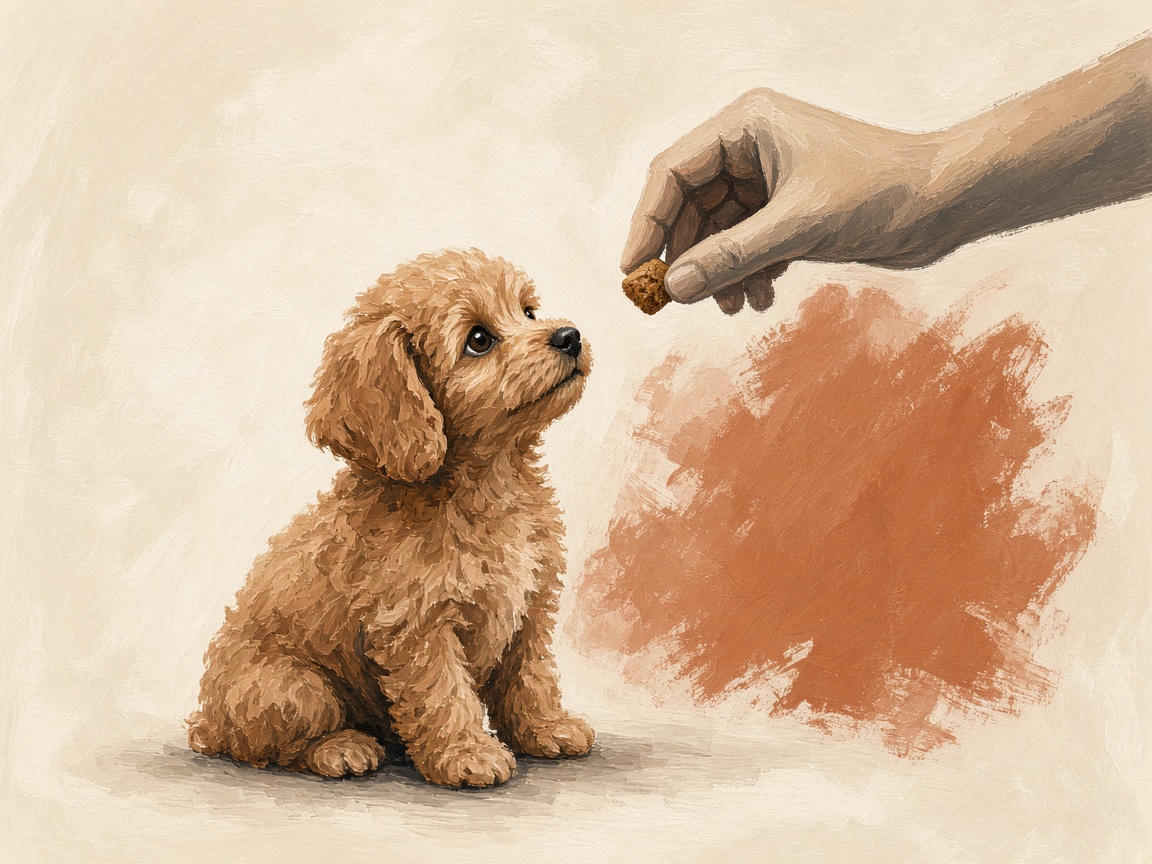
It is exploration, not a verdict
A new toy poodle puts the mouth on hands, sleeves, and the table leg because that is how a puppy checks what is allowed. It is not spite, and it is not a personality you have to live with. The first weeks are when this is loudest. It gets duller when the toy is more interesting than your fingers, and when sleep is protected. One lecture does not finish it.
In the moment
- Stop moving your hands. A wriggling hand is a toy.
- Offer a chew they can have safely. Not your sleeve as the substitute.
- Praise them when the mouth is on the toy.
- If they are already past listening, end the game. A nap beats another round.
Ankles are the same game with a moving target. Stand still. Then the toy. Chasing you down the hall teaches them that legs are fun.
If a child is the one being chewed, the child leaves the game. You stay. A child should not be the person teaching a puppy what a bite is.
What makes the next bite more likely
- Rough hand games. If wrestling your fingers always ends in a bite, stop wrestling your fingers.
- Another game in the hour they are already frantic.
- Punishing the bite after you already pulled your hand away. They learn that hands are exciting, not that teeth were the problem.
The short version of this, inside the first month, is the bitey puppy. The wildest hour is often an overtired puppy. How much a puppy sleeps is the other half of the plan.
When the mouth is sore
Teething makes the chew bigger. A safe chew is the job, not your fingers, and not a hard bone that can crack a small tooth. The habit for the teeth themselves is in toy poodle teeth. A swollen face, blood, or chewing on only one side is not teething you push through.
When it is more than play
Get help if bites keep breaking skin, if the body goes stiff and the growl is not the play sound you already know, or if the puppy seems painful, suddenly different, or unwell. That is a veterinarian and a qualified trainer. A harder correction does not teach a puppy who is scared or sore.
Questions owners ask
Why is my toy poodle puppy biting?
The mouth is how they explore, and the teeth are changing. It is not spite. If they are already wild, they often need sleep, not another game.
How do I stop a toy poodle puppy biting my hands?
Stop moving your hands. Offer a toy and praise the toy. A moving ankle is the same game, so stand still. Do not yell, and do not hold the mouth shut.
When is toy poodle puppy biting a problem for a vet or a trainer?
Get help if bites keep breaking skin, if the body goes stiff and the growl is not play, or if the puppy seems painful or suddenly different. That is a veterinarian and a qualified trainer, not a harder correction.
The toy gets the praise
You are not raising a dog who never uses a mouth. You are teaching that the mouth has a place, and that your hand is not it.
Start your First 30 DaysOwner routines, not a veterinary diagnosis. Bites that keep breaking skin, or a puppy who seems painful or suddenly different, belong with a veterinarian and a qualified trainer.